- Usb Installer For Windows 7
- Hackintosh Yosemite Usb Installer
- Usb Installer Download
- Free Usb Installer
- Create Usb Yosemite Installer
There is a very simple on line command to create the full Yosemite. Installer on a USB stick. The command line function is hidden. Inside the Yosemite installer itself. First, obviously the USB stick needs to be formatted to a single GUID. Partition with OS X extended, journaled filesystem. You will also need to. Download Hackintosh Yosemite Intel + AMD Support. Hackintosh Yosemite Installer can be used to install OS X Yosemite On PC without the need of a Mac. HP Processors with Insyde Bios. Use the DMG for Flash drive installation and use ISO for DVD Installation or Installing on a Virtual Machines. Many Improvements from 10.10. However, if you wish for a complete clean install of OS X’s latest on your Mac, the best way to go about this is to create a bootable USB drive of Yosemite. In this guide we will show you how to do just that. The older method used to make bootable drives of OS X Lion and Mountain Lion installer did not work for OS X Mavericks. Launch the installer and it will display a splash screen. Click Continue, and the following screen is displayed. Click the 'Show All Disks' button. Select your flash drive, in this case 'Yosemite. Apr 29, 2015 As soon as you hear the Mac bootup ‘Chime’ hold down the Option (or Alt) key and select the USB drive (which should be an orange colour). Double click the icon with the mouse or use the cursor keys to move to that image and then press Enter. This will start the Yosemite Installer, which may take a few minutes depending on the speed of your.
This tutorial is going to show you how to create or restore Mac OS X dmg file into a USB flash disk. In other case, we can create Mac OS X bootable flash disk with this method. I am using Trans Mac version 11.1 on this tutorial. Trans Mac is a Windows application that can be used to restore dmg files and create Mac bootable USB disk. Bejeweled 3 free. download full version crack.
TransMac features:

- Open Mac format disk drives, flash drives, CD/DVD/Blu-ray media, dmg, dmgpart, sparseimage and sparsebundle files.
- Copy files to Mac disks and dmg images.
- Format for Mac and restore disks and flash drives.
- Create, compress and expand (convert to iso) dmg files.
- Built in media burner functionality to burn ISO and dmg files directly to CD/DVD/Blu-Ray.
- Read Mac multi
1. Download TransMac from the official website. You may try this software for 14 days for free
2. Install TransMac on Windows
3. Insert USB disk and then Open TransMac. Right click onthe USB Flash disk and select Format Disk for Mac. Please note that this command will erase the entire disk and format it.
The workaround is to create a bootable USB flash drive containing the OS X Yosemite installer. While it's easiest to use a USB flash drive as the destination for the installer, you can use any bootable media, including hard drives, SSDs, and USB flash drives. WizDMG offers an intuitive interface with no clutter and full functionality to handle DMG files. Apart from burning such disk image files to DVD/CD or USB, it also gives you edit options where you can add and remove files from within the DMG file, rename DMG files and even create DMGs from files and folders on your desktop.
Create an El Capitan Installer ISO with VirtualBox from the Recovery image; Create other Installer USBs from El Capitan in VirtualBox; Create the Recovery ISO. The Apple download contains a recovery image called BaseSystem.dmg which needs to be copied to a correctly partitions and formatted recovery USB or ISO. Download the OS X El Capitan. Once your USB drive is done formatting, right-click it again and click “Restore with Disk Image”. A file selection window will pop up; choose your Yosemite Zone disk image file (it will probably be called “Yosemite-Zone.dmg”), and proceed. Now, TransMac will write Yosemite Zone onto your USB drive. Use the Restore Disk Image to Drive dialog box to browse for the DMG file with the installation files for Mac OS X Yosemite in this case, and click the OK button to create a bootable USB of the operating system. Now, you’ll have to wait a long time.
4. Once finished, right click on the usb disk again and select Restore with Disk Image
Browse your DMG file and press OK.
These advanced steps are primarily for system administrators and others who are familiar with the command line. You don't need a bootable installer to upgrade macOS or reinstall macOS, but it can be useful when you want to install on multiple computers without downloading the installer each time.
What you need to create a bootable installer
- A USB flash drive or other secondary volume formatted as Mac OS Extended, with at least 14GB of available storage
- A downloaded installer for macOS Big Sur, Catalina, Mojave, High Sierra, or El Capitan
Download macOS
Create Yosemite Usb From Dmg Usb
- Download: macOS Big Sur, macOS Catalina, macOS Mojave, or macOS High Sierra
These download to your Applications folder as an app named Install macOS [version name]. If the installer opens after downloading, quit it without continuing installation. To get the correct installer, download from a Mac that is using macOS Sierra 10.12.5 or later, or El Capitan 10.11.6. Enterprise administrators, please download from Apple, not a locally hosted software-update server. - Download: OS X El Capitan
This downloads as a disk image named InstallMacOSX.dmg. On a Mac that is compatible with El Capitan, open the disk image and run the installer within, named InstallMacOSX.pkg. It installs an app named Install OS X El Capitan into your Applications folder. You will create the bootable installer from this app, not from the disk image or .pkg installer.
Use the 'createinstallmedia' command in Terminal
- Connect the USB flash drive or other volume that you're using for the bootable installer.
- Open Terminal, which is in the Utilities folder of your Applications folder.
- Type or paste one of the following commands in Terminal. These assume that the installer is in your Applications folder, and MyVolume is the name of the USB flash drive or other volume you're using. If it has a different name, replace
MyVolumein these commands with the name of your volume.
Big Sur:*
Catalina:*
Mojave:*
High Sierra:*
El Capitan:
* If your Mac is using macOS Sierra or earlier, include the --applicationpath argument and installer path, similar to the way this is done in the command for El Capitan.
After typing the command:
- Press Return to enter the command.
- When prompted, type your administrator password and press Return again. Terminal doesn't show any characters as you type your password.
- When prompted, type
Yto confirm that you want to erase the volume, then press Return. Terminal shows the progress as the volume is erased. - After the volume is erased, you may see an alert that Terminal would like to access files on a removable volume. Click OK to allow the copy to proceed.
- When Terminal says that it's done, the volume will have the same name as the installer you downloaded, such as Install macOS Big Sur. You can now quit Terminal and eject the volume.
Use the bootable installer
Determine whether you're using a Mac with Apple silicon, then follow the appropriate steps:
Apple silicon
- Plug the bootable installer into a Mac that is connected to the internet and compatible with the version of macOS you're installing.
- Turn on your Mac and continue to hold the power button until you see the startup options window, which shows your bootable volumes and a gear icon labled Options.
- Select the volume containing the bootable installer, then click Continue.
- When the macOS installer opens, follow the onscreen instructions.
Intel processor
- Plug the bootable installer into a Mac that is connected to the internet and compatible with the version of macOS you're installing.
- Press and hold the Option (Alt) ⌥ key immediately after turning on or restarting your Mac.
- Release the Option key when you see a dark screen showing your bootable volumes.
- Select the volume containing the bootable installer. Then click the up arrow or press Return.
If you can't start up from the bootable installer, make sure that the External Boot setting in Startup Security Utility is set to allow booting from external media. - Choose your language, if prompted.
- Select Install macOS (or Install OS X) from the Utilities window, then click Continue and follow the onscreen instructions.
Learn more
For more information about the createinstallmedia command and the arguments that you can use with it, make sure that the macOS installer is in your Applications folder, then enter the appropriate path in Terminal:
- Big Sur: /Applications/Install macOS Big Sur.app/Contents/Resources/createinstallmedia
- Catalina: /Applications/Install macOS Catalina.app/Contents/Resources/createinstallmedia
- Mojave: /Applications/Install macOS Mojave.app/Contents/Resources/createinstallmedia
- High Sierra: /Applications/Install macOS High Sierra.app/Contents/Resources/createinstallmedia
- El Capitan: /Applications/Install OS X El Capitan.app/Contents/Resources/createinstallmedia
Create Yosemite Usb From Dmg Windows 10
A bootable installer doesn't download macOS from the internet, but it does require an internet connection to get firmware and other information specific to the Mac model.
Mac OS users who are already running Mavericks on their desktop computers are now eligible for free upgrade to OS X 10.10 – Yosemite.
Those who are facing performance issues with direct upgrade via App store or installing OS X for the first time on their Macs can follow a simple step-by-step guide to perform a clean install of Yosemite using Disk Utility.
Before we delve into the detailed process of clean installing OS X Yosemite on Macs, there are a few things that need to be taken care of.
Prerequisites
Usb Installer For Windows 7
a) Ensure your Mac is compatible with OS X Yosemite. These are the supported devices:
- iMac (Mid 2007 or newer)
- MacBook (Late 2008 Aluminium, or Early 2009 or newer)
- MacBook Pro (Mid/Late 2007 or newer)
- MacBook Air (Late 2008 or newer)
- Mac mini (Early 2009 or newer)
- Mac Pro (Early 2008 or newer)
- Xserve (Early 2009)
b) Back up important data and settings (photos, videos, music files, documents and the like) on your Mac to an external hard drive. You can do this by using the Time Machine feature in Mac OS X, or third-party software such as Carbon Copy Cloner.
c) Create a bootable USB flash drive with a storage size of at least 8GB.
d) Download OS X 10.10 Yosemite Final from the Mac App Store and save it to the Applications folder – its default location.
How to Create Bootable USB Flash Drive
First, create bootable USB flash drive. Here is how you do it, courtesy of Redmond Pie:
- Plug in your USB drive into the computer and open Disk Utility (in Applications).
- Select the USB drive from the left sidebar and click on Erase tab.
- Choose Mac OS Extended (Journaled) in the format box and let the name be Untitled (default).
- Now click on Erase button and wait until the format process completes.
- Then choose Partition tab and select 1 Partition from Partition Layout dropdown menu. Click on Option and ensure GUID Partition Table is selected as the partition scheme, with its name set to Untitled.
- After downloading the OS X 10.10 Yosemite instakker from the Mac App Store, just quit the installer and set the downloaded file's name to Install OS X Yosemite.app.
- Launch the Terminal app (in Applications/Utilities) and type or paste the following command in, and then hit Enter:
sudo /Applications/Install OS X Yosemite.app/Contents/Resources/createinstallmedia –volume /Volumes/Untitled –applicationpath /Applications/Install OS X Yosemite.app –nointeraction
- This will create the bootable USB flash drive. This takes between 10-20 minutes. Do not interrupt the Terminal or eject the flash drive during the process. Once the process completes, you will see the message 'Copy Complete. Done.'
The OS X Yosemite bootable USB flash drive will be ready for use and you can start the clean installation process.
How to Clean Install OS X Yosemite on Your Mac
Step 1: Ensure the bootable USB flash drive is plugged into your Mac and restart the computer. As soon as the start-up chime plays, press the Option key (Alt).
Step 2: Choose the USB drive on the start-up drive selection screen and hit Enter/Return on the keyboard.
Step 3: Wait until the Yosemite installer appears on screen. This could take a few seconds or minutes.
Step 4: Click on Disk Utility and then hit Continue.
Step 5: Click on Macintosh HD from the left hand-side pane and then hit Erase tab on the top-right portion of the window. Leave all the settings at their default values and then hit Erase button at the bottom right. This will wipe all files stored on your startup hard drive.
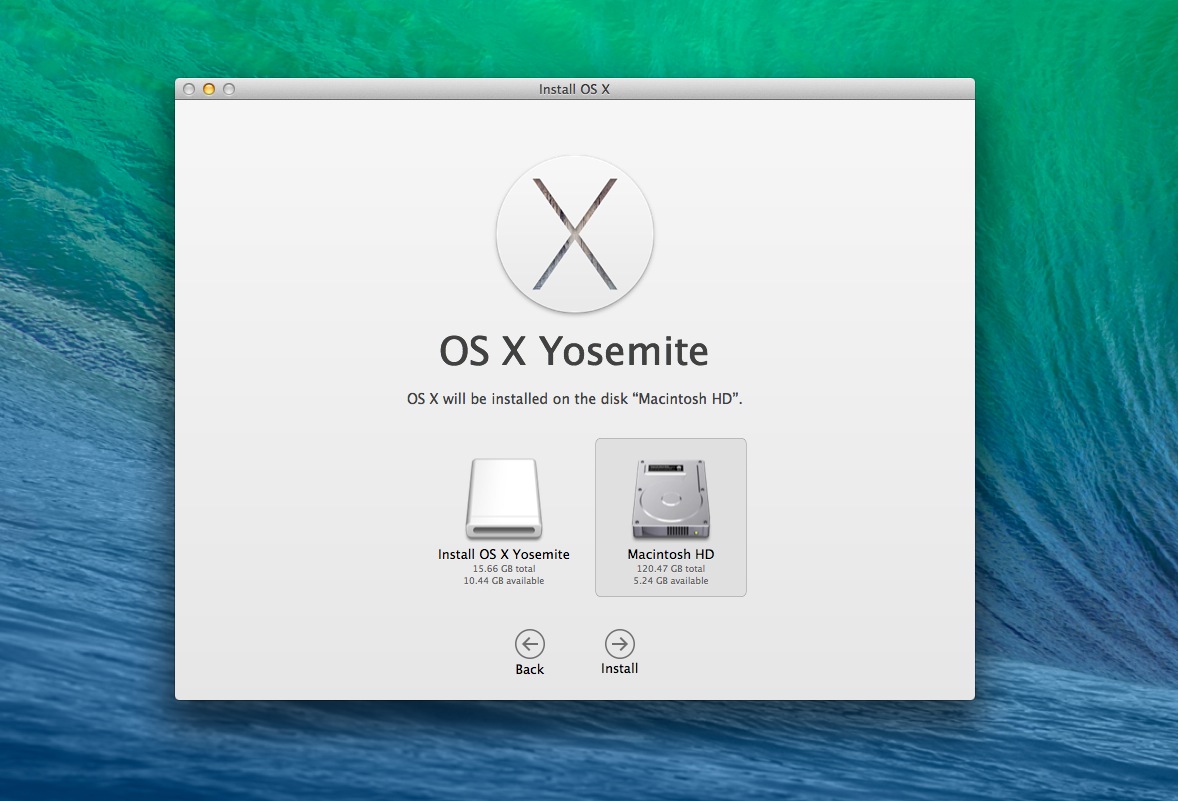
Step 6: When the erasing process is complete, return to the first screen where you selected Disk Utility. Now click on Install OS X and then hit Continue.
Hackintosh Yosemite Usb Installer
Step 7: Choose the Macintosh HD partition you erased in step 5 and then click Install.
Usb Installer Download
If you have followed all the steps correctly, your computer should now boot right into the newly installed operating system, OS X Yosemite, and you could cherish its stunning new UI.
(Source: Redmond Pie)
Free Usb Installer

Create Usb Yosemite Installer
How to Clean Install OS X Yosemite via Bootable USB Flash Drive