Free Python Runner

Free Python RunnerFree python runner game

Online Python Compiler, Online Python Editor, Online Python IDE, Python Coding Online, Practice Python Online, Execute Python Online, Compile Python Online, Run Python Online, Online Python Interpreter, Execute Python Online (Python v2.7.13). Write and run Python code using our online compiler (interpreter). You can use Python Shell like IDLE, and take inputs from the user in our Python compiler. Free Python Hosting – Stuff I Wish I Knew Sooner Somewhere out there, I’m sure there is a hosting company that proactively explains their limitations before you give them your credit card. There are a lot of people out there who can “host” Python applications – if you handle the dirty work of setting up an un-configured VPS. Python offers a series of command-line options that you can use according to your needs. For example, if you want to run a Python module, you can use the command python -m. The -m option searches sys.path for the module name and runs its content as main: $ python3 -m hello Hello World! Your python code is formatted in a clean and consistent way using yapf. This reduces cognitive load reading source code, and ensures all code written by your team has a consistent and beautiful style. Python code formatting works with pure.py files and Jupyter Notebooks running a Python kernel.

Python is a very simple language, and has a very straightforward syntax.It encourages programmers to program without boilerplate (prepared) code.The simplest directive in Python is the 'print' directive -it simply prints out a line (and also includes a newline, unlike in C).

There are two major Python versions, Python 2 and Python 3. Python 2 and 3 are quite different.This tutorial uses Python 3, because it more semantically correct and supports newer features.

For example, one difference between Python 2 and 3 is the print statement.In Python 2, the 'print' statement is not a function, and therefore it isinvoked without parentheses. However, in Python 3, it is a function, and must be invokedwith parentheses.

To print a string in Python 3, just write:

Indentation
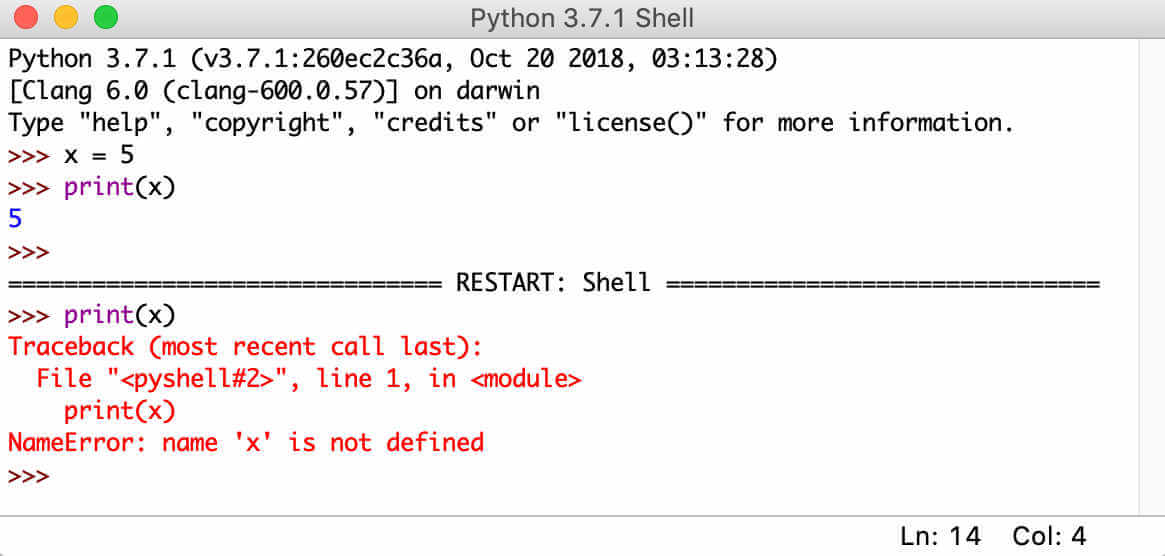
Free Python Runner

Python uses indentation for blocks, instead of curly braces. Both tabs and spaces are supported, but the standardindentation requires standard Python code to use four spaces. For example:

Free Python Runner Training

Exercise

Python Runner File

Use the 'print' function to print the line 'Hello, World!'.

Idle Python 3.5 Download

A Visual Studio Code extension provides some common untilities for PySide6, PyQt6 and PyQt5.

Qt Markup Language (qml)Qt Style Sheets (qss)Resource Collection Files (qrc)
qmake Files (pro)Qt Linguist Translation (qt.ts)QML Module Definition Files (qmldir)

Highlight Features

  • Qt Markup Language (*.qml) highlighting and snippets support
  • QML Module Definition Files (*.qmldir) highlighting and snippets support
  • Qt Style Sheets (*.qss) highlighting and snippets support
  • Qt Linguist Translation (*.qt.ts) highlighting support (XML)
  • Resource Collection Files (*.qrc) highlighting support (XML)
  • Qt Designer Form (*.ui) highlighting support (XML)
  • Qt Creator User Settings (*.pro.user) highlighting support (XML)
  • qmake highlighting support
  • New or open form (Qt Designer *.ui file)
    • Automatically get designer from installed Qt for Python modules or set manually
  • Compile form (Qt Designer *.ui file) into Python file (require PySide6, PyQt6, PySide2 or PyQt5 to be installed)
    • Automatically get uic from installed Qt for Python modules or set manually
    • Automatically re-compile on form files changed
  • Update translation (Qt Linguist *.qt.ts file) from Python file (require PyQt6, PySide2 or PyQt5 to be installed)
    • Automatically get lupdate from installed Qt for Python modules or set manually
    • Automatically re-update on form files changed
  • Compile Qt Resource File (*.qrc) into Python file (require PySide6, PySide2 or PyQt5 to be installed)
    • Automatically get rcc from installed Qt for Python modules or set manually
    • Automatically re-compile on resource files changed

Supported Environment Variables

The following list shows the supported environment variables you can use for the path of Qt tools in configurations.

Predefined Variables

  • ${workspaceFolder} - the path of the folder opened in VS Code
  • ${workspaceFolderBasename} - the name of the folder opened in VS Code without any slashes (/)
  • ${file} - the current opened file
  • ${fileWorkspaceFolder} - the current opened file's workspace folder
  • ${relativeFile} - the current opened file relative to workspaceFolder
  • ${relativeFileDirname} - the current opened file's dirname relative to workspaceFolder
  • ${fileBasename} - the current opened file's basename
  • ${fileBasenameNoExtension} - the current opened file's basename with no file extension
  • ${fileDirname} - the current opened file's dirname
  • ${fileExtname} - the current opened file's extension
  • ${cwd} - the task runner's current working directory on startup
  • ${lineNumber} - the current selected line number in the active file
  • ${selectedText} - the current selected text in the active file
  • ${execPath} - the path to the running VS Code executable
  • ~~${defaultBuildTask} - the name of the default build task~~ (currently not supported)
  • ${pathSeparator} - the character used by the operating system to separate components in file paths

The example of predefined variables can be found here.

System Environment Variables

You can also reference environment variables through the ${env:Name} syntax (for example, ${env:USER}).

Be sure to match the environment variable name's casing, for example, ${env:Path} on Windows.

Requirements

  • Python
  • Python Visual Studio Code Extension with python.pythonPath configuration (defaults to python)
  • Qt for Python packages including PySide6, PyQt6, PySide2 and PyQt5.

Release Notes

Please see the release notes in CHANGELOG.